5/3/1 is one of the most popular strength programs ever written, and for good reason: it’s simple, it works for years, and it doesn’t burn you out. The catch is the math. Every set is a percentage of a training max, not your real max, and working all of that out by hand for four lifts gets old fast.
The calculator below does it for you. Enter your one-rep max for the squat, bench, deadlift and overhead press, and you’ll get every working set for a full cycle, rounded to plates you actually have. Then we’ll go through how the program works and how to run it.
5/3/1 Calculator
5/3/1 Calculator
Enter your one-rep max for any lift. Leave a box empty to skip that lift.
Don’t know your 1RM? Estimate it from a set
What Is 5/3/1?
5/3/1 is a strength program created by powerlifter Jim Wendler (this 5/3/1 primer is a good summary of the variations). It’s built around four main lifts (squat, bench press, deadlift and overhead press), and each training cycle runs in waves: a week of fives, a week of threes, then a week of 5, 3 and 1. The name comes from that third week.
The big idea is to start lighter than you think and progress slowly. Instead of chasing new maxes every week, you add a small amount to each lift every cycle and let the last set of each workout show you how much stronger you’re getting.
What Is a Training Max?
Every percentage in 5/3/1 is based on your training max, which is 90% of your one-rep max in the standard version. Some variations use 85%. So if your squat max is 315 lb, your training max is about 285 lb, and that’s the number all your sets are worked out from.
Using a lower number on purpose keeps the weights manageable, so you can hit good reps week after week instead of grinding. If you’re not sure of your max, use the estimator in the calculator or read our guide on how to calculate one rep max. We also explain the difference in detail in training max vs one rep max.
5/3/1 Percentages by Week
Here are the working sets for each week, as percentages of your training max. A “+” means the last set is as many reps as possible, but you should stop a rep or two short of failure.
| Week | Set 1 | Set 2 | Set 3 |
|---|---|---|---|
| Week 1 (5s) | 65% x 5 | 75% x 5 | 85% x 5+ |
| Week 2 (3s) | 70% x 3 | 80% x 3 | 90% x 3+ |
| Week 3 (5/3/1) | 75% x 5 | 85% x 3 | 95% x 1+ |
| Week 4 (deload) | 40% x 5 | 50% x 5 | 60% x 5 |
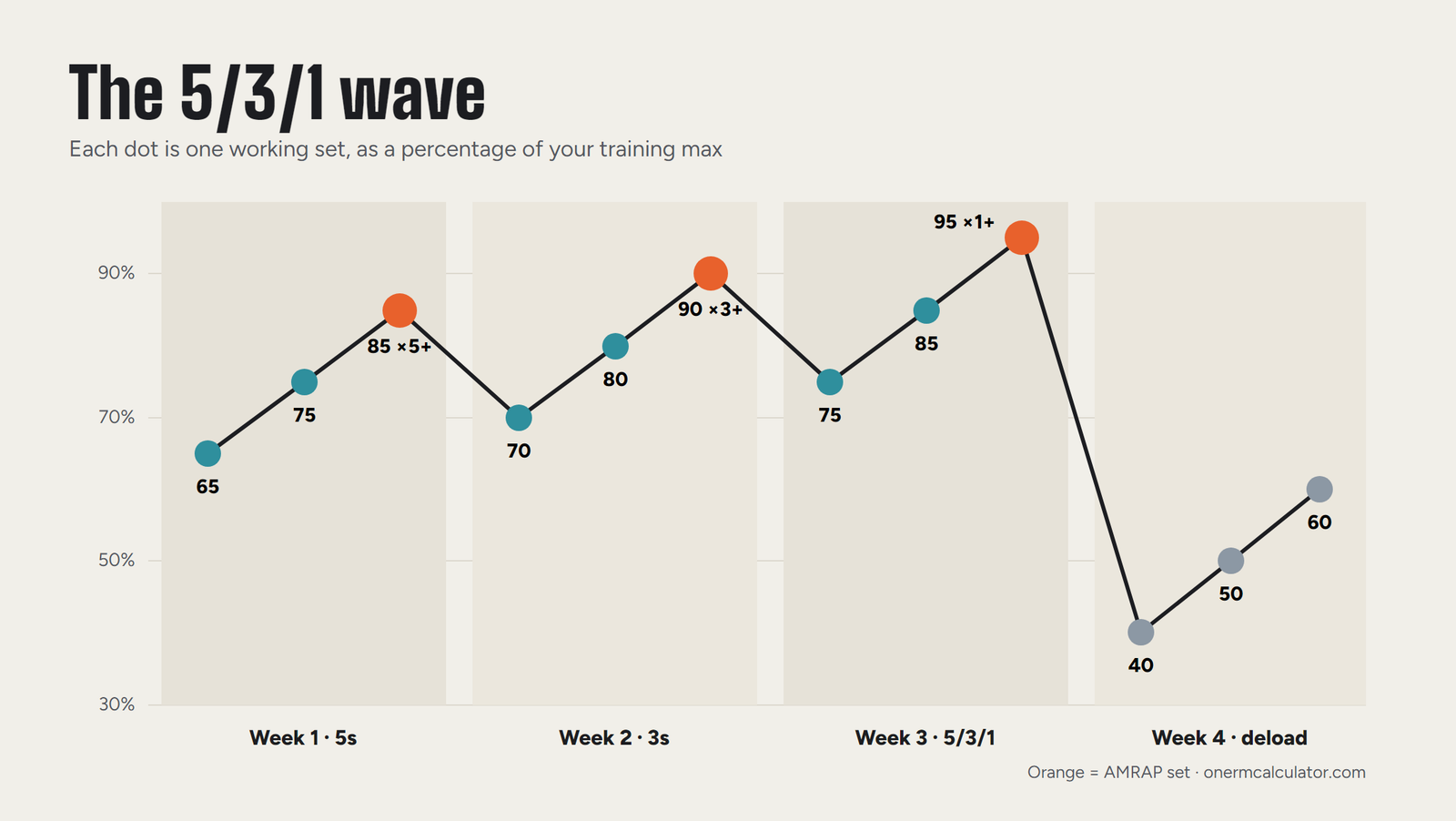
The deload week is how the original program was laid out, with an easy week every fourth week. Newer versions of 5/3/1 have moved away from deloading every fourth week and use a deload or training max test week after a few cycles instead. Either way, plan for regular lighter weeks, because they’re what let you keep progressing.
Example: A 315 lb Squat
Here’s what one cycle looks like for a lifter with a 315 lb squat, using a 285 lb training max and rounding to the nearest 5 lb:
| Week | Set 1 | Set 2 | Set 3 |
|---|---|---|---|
| Week 1 | 185 x 5 | 215 x 5 | 240 x 5+ |
| Week 2 | 200 x 3 | 225 x 3 | 255 x 3+ |
| Week 3 | 215 x 5 | 240 x 3 | 270 x 1+ |
| Week 4 | 115 x 5 | 140 x 5 | 170 x 5 |
Notice that the heaviest set of the whole cycle is 270 lb, well below the 315 lb max. That’s the point. Most lifters can get several reps at 270, which makes that last set a great check on how much stronger you’re getting.
How to Progress Each Cycle
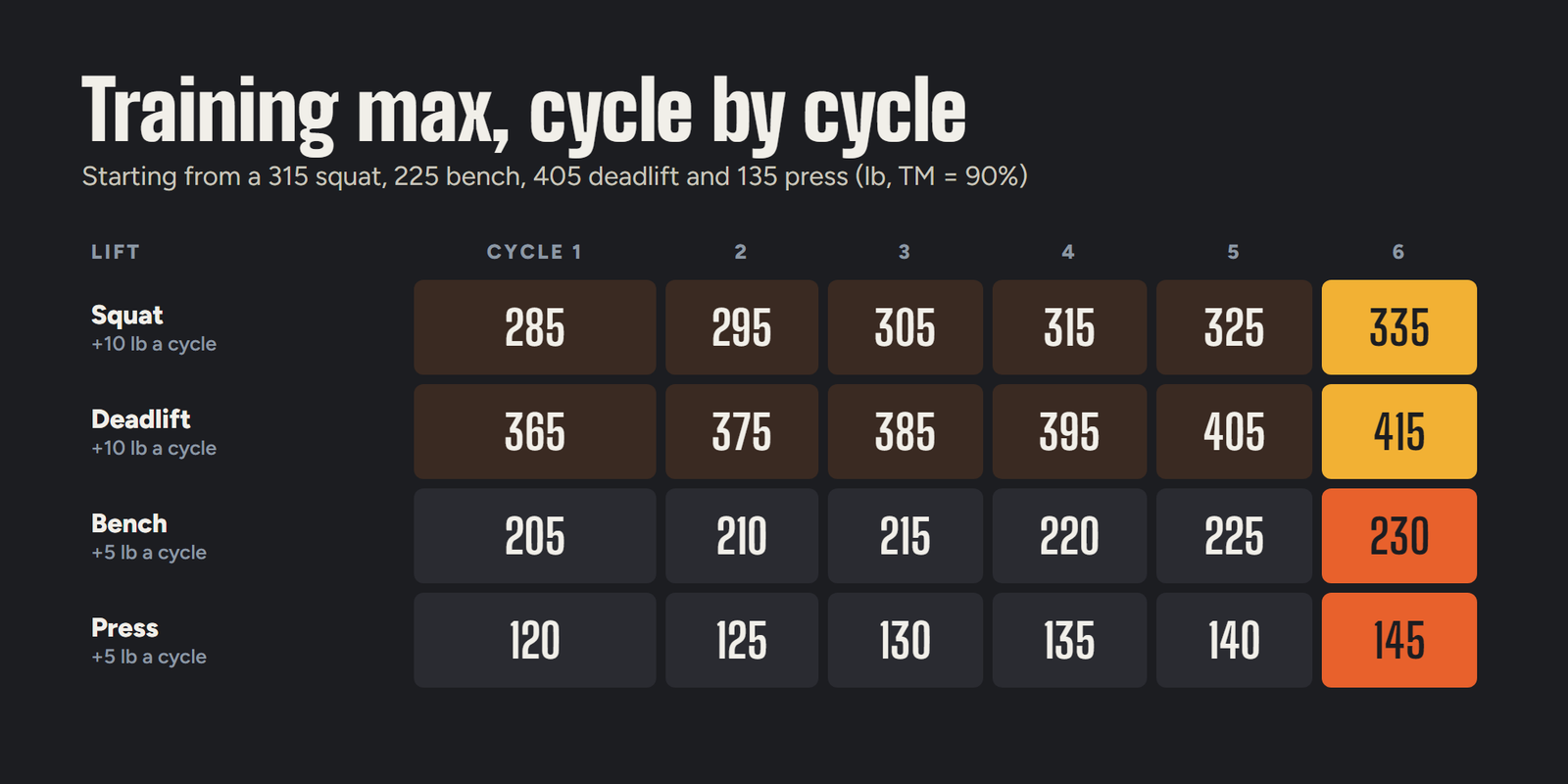
After each cycle, add a small amount to your training max and start again:
- Bench press and overhead press: add 5 lb (about 2.5 kg).
- Squat and deadlift: add 10 lb (about 5 kg).
That sounds slow, but small jumps every few weeks add up to a lot over a year, and they’re small enough that you can keep making them. If you start missing the minimum reps on your “+” sets, your training max is too high. Drop it by about 10% and build back up. To check your real max along the way, see how often you should test your one rep max.
Tips for Running 5/3/1
- Warm up properly. Do a few lighter sets before your first working set, especially on heavy weeks.
- Don’t max out on the + sets. Leave a rep or two in the tank. If you like to train by effort, our RPE chart is a good guide.
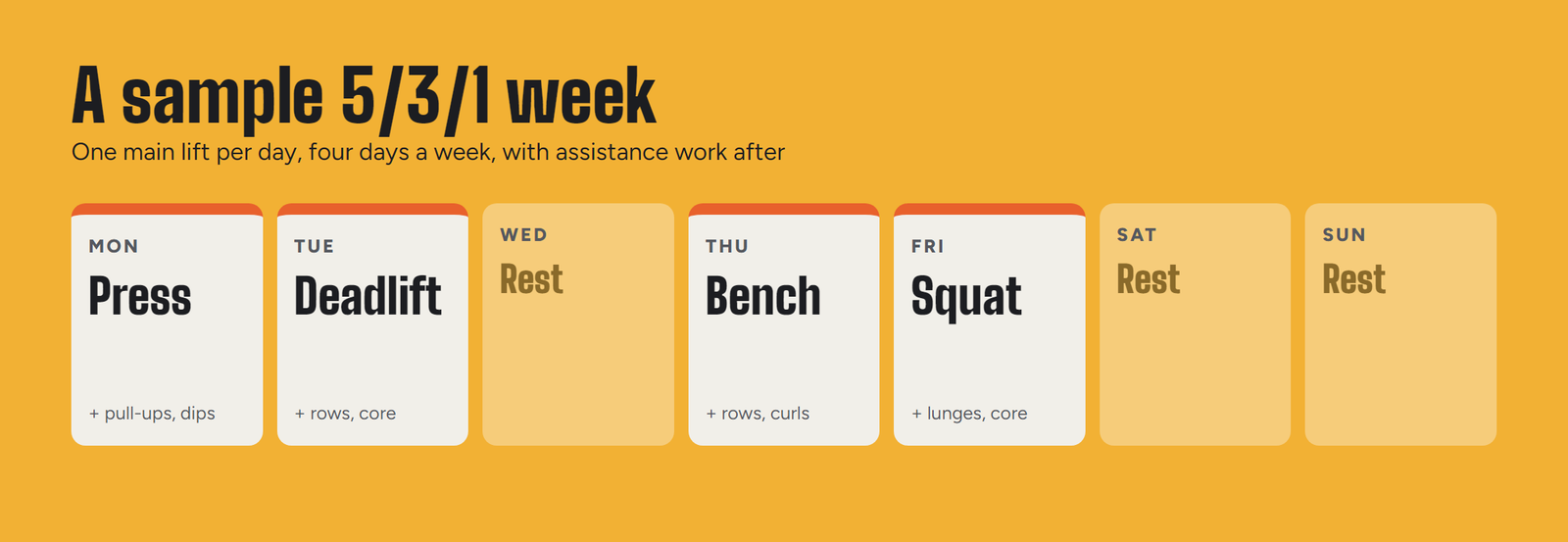
- Add assistance work. The main lifts take about 15 minutes. Most templates add rows, pull-ups, dips and core work after.
- Be patient. The program is designed to work over months and years, not weeks.
FAQ
What percentage is a 5/3/1 training max?
The standard training max is 90% of your one-rep max. Some 5/3/1 variations use 85%.
What are the 5/3/1 percentages?
Week 1 is 65%, 75% and 85% for 5 reps, week 2 is 70%, 80% and 90% for 3 reps, and week 3 is 75% for 5, 85% for 3 and 95% for 1 or more. All are percentages of your training max.
How much should I add each 5/3/1 cycle?
Add 5 lb to your bench press and overhead press, and 10 lb to your squat and deadlift, after each cycle.
Is 5/3/1 good for beginners?
Yes. It’s simple and progresses slowly, which suits many beginners. Some complete beginners progress faster on a program that adds weight every session, then switch to 5/3/1 once that stalls.
Do you still need a deload week on 5/3/1?
The original program used a deload every fourth week. Newer versions use a deload or test week after a few cycles instead. Either way, regular lighter weeks are part of the plan.
Final Thoughts
5/3/1 works because it’s patient. You start with a training max a bit below your real max, follow the 5s, 3s and 5/3/1 weeks, push the last set without going to failure, and add a little weight every cycle. Plug your numbers into the calculator above, print out your weeks, and the hard part is just showing up. For more on where your lifts stand, try our one rep max calculator.