Your total is 600 kg. Your training partner’s is 500 kg. Who’s actually stronger? If you weigh 110 kg and they weigh 67 kg, it’s probably not you. That’s the problem the Wilks score solves: it adjusts your powerlifting total for bodyweight so lifters of any size can be compared.
Use the calculator below to get your Wilks score, plus the newer 2020 version, from your squat, bench and deadlift total. Then we’ll cover how it works, what counts as a good score, and how it compares with DOTS.
Wilks Score Calculator
Uses the original Wilks coefficients and the 2020 update, with the same bodyweight limits OpenPowerlifting uses. Scores are calculated in kilograms; pounds are converted for you.
What Is the Wilks Score?
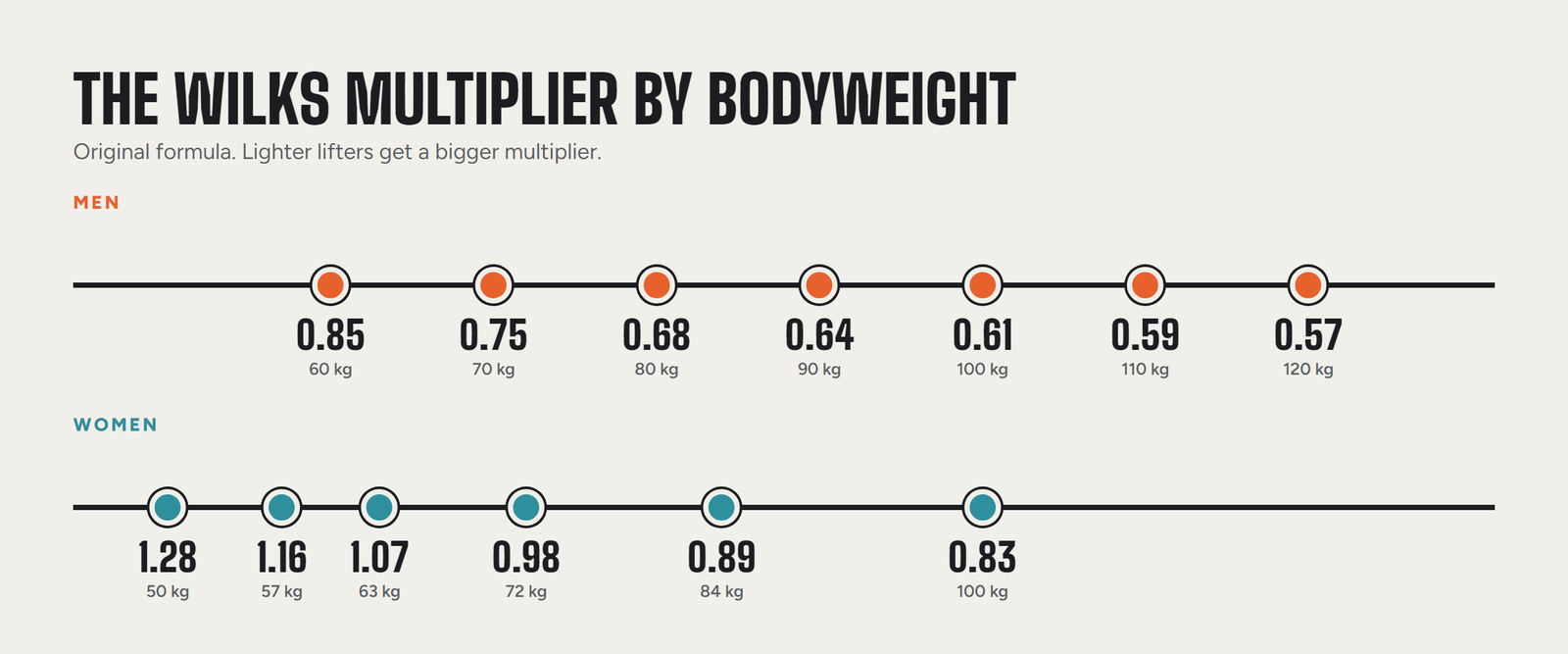
The Wilks score (or Wilks coefficient) is a formula created by Robert Wilks of Powerlifting Australia. It multiplies your total by a coefficient based on your bodyweight. Lighter lifters get a bigger multiplier, heavier lifters a smaller one, so a 60 kg lifter and a 120 kg lifter can be ranked on the same list.
For decades it was the standard way to crown the "best lifter" at a meet. The IPF used it until the end of 2018 before switching to its own scoring formulas, and many lifters and federations still talk in Wilks because it's the number everyone grew up with.
The Wilks Formula
The original formula is:
Wilks = Total (kg) × 500 / (a + b·x + c·x² + d·x³ + e·x⁴ + f·x⁵), where x is bodyweight in kilograms.
| Coefficient | Men | Women |
|---|---|---|
| a | -216.0475144 | 594.31747775582 |
| b | 16.2606339 | -27.23842536447 |
| c | -0.002388645 | 0.82112226871 |
| d | -0.00113732 | -0.00930733913 |
| e | 0.00000701863 | 0.00004731582 |
| f | -0.00000001291 | -0.00000009054 |
Bodyweight is capped at the ends of the curve (40 to 201.9 kg for men, 26.51 to 154.53 kg for women in OpenPowerlifting's implementation) so the formula doesn't produce nonsense at extreme weights.
Wilks 2020
In 2020 Powerlifting Australia released an updated version, often called Wilks 2020 or Wilks2. It uses new coefficients fitted to more recent results and is scaled around 600 instead of 500, so Wilks 2020 scores are higher than original Wilks scores for the same lift. Don't compare one with the other.
Wilks Score Examples
| Lifter | Bodyweight | Total | Wilks | Wilks 2020 |
|---|---|---|---|---|
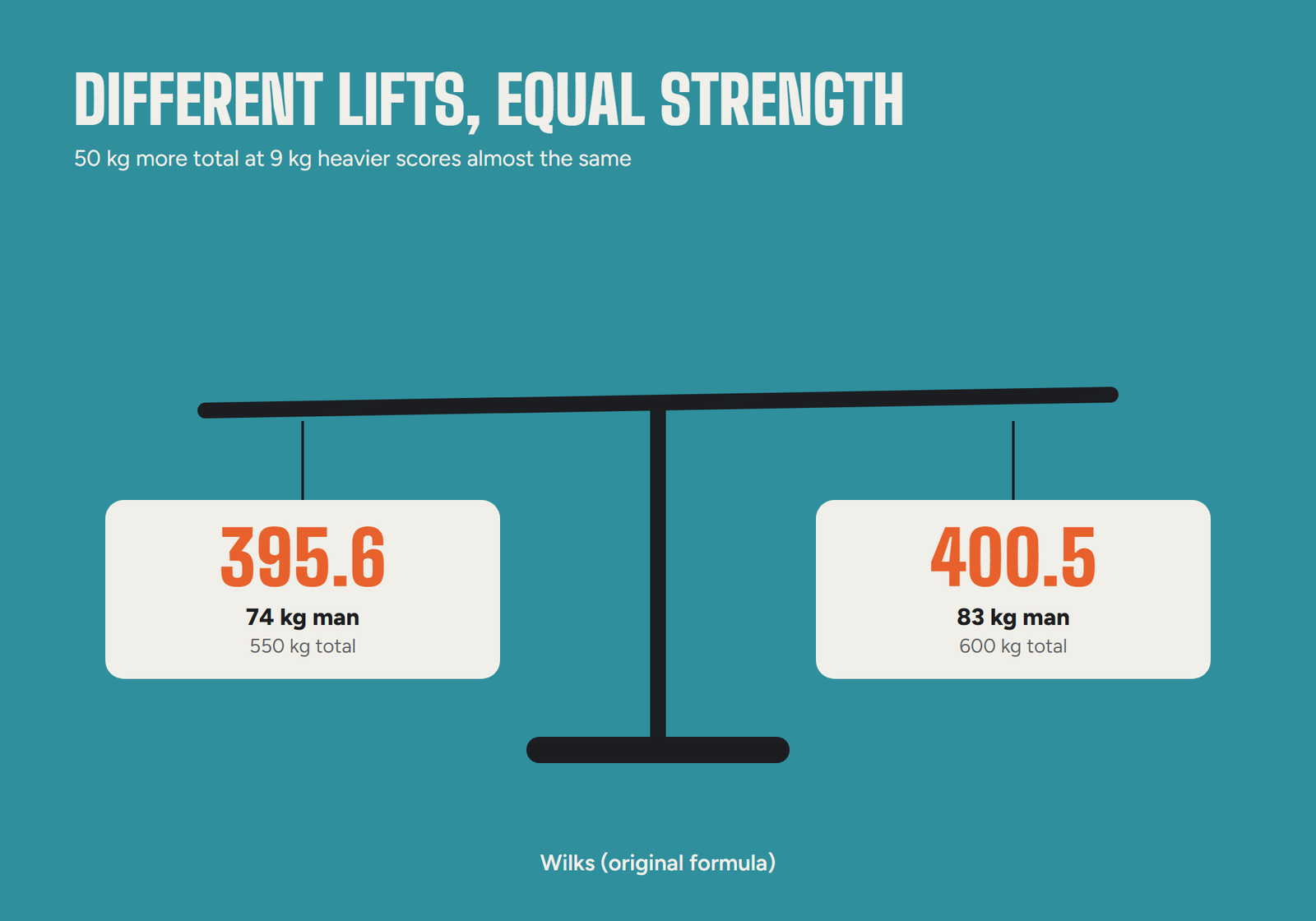
| Man | 74 kg | 550 kg | 395.6 | 473.0 |
| Man | 83 kg | 600 kg | 400.5 | 481.0 |
| Man | 100 kg | 700 kg | 426.0 | 510.6 |
| Woman | 57 kg | 330 kg | 382.9 | 450.8 |
| Woman | 63 kg | 400 kg | 429.6 | 511.4 |
| Woman | 72 kg | 450 kg | 439.2 | 534.1 |
Notice how the 74 kg man with a 550 kg total scores almost the same as the 83 kg man with 600 kg. That's the point: 50 kg more total at 9 kg heavier is roughly an equal performance.
What Is a Good Wilks Score?
There's no official grading, but these rough bands are widely used in the powerlifting community for the original Wilks formula. Treat them as a guide, not a rule.
| Wilks (original) | Rough level |
|---|---|
| Under 250 | Beginner |
| 250 to 350 | Intermediate |
| 350 to 450 | Advanced, competitive at local meets |
| 450 to 550 | National level |
| Over 550 | Elite, international |
Wilks vs DOTS vs IPF GL
Wilks isn't the only way to compare lifters. DOTS is a newer formula many federations now use, and the IPF has its own GL points. Each one weights bodyweight a little differently, so the same lift can rank higher on one than another. If you want the DOTS version of your total, use our DOTS calculator.
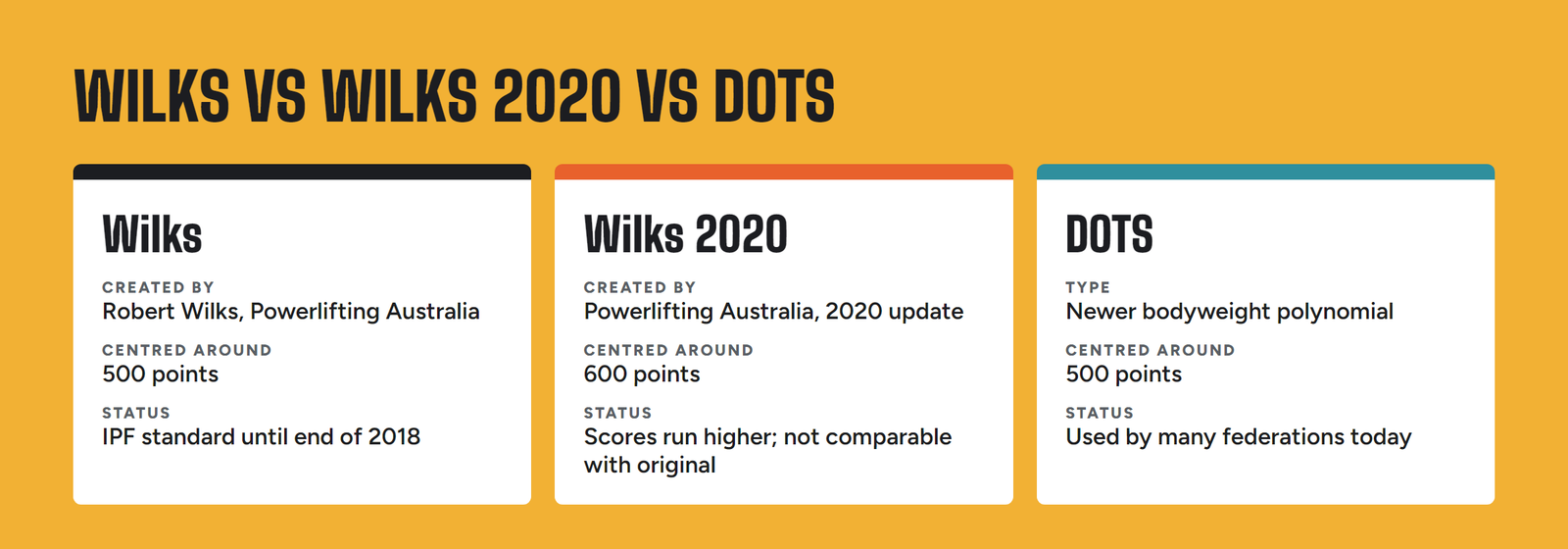
- Wilks (original): the classic, centred around 500. Still the most recognised number.
- Wilks 2020: updated coefficients, centred around 600. Scores aren't comparable with the original.
- DOTS: a newer polynomial formula that many argue treats heavy lifters more fairly.
Don't know your maxes yet? Estimate them first with our one rep max calculator, and use the RPE chart to plan your training sets.
FAQ
How do you calculate a Wilks score?
Add your best squat, bench press and deadlift to get your total in kilograms, then multiply it by your Wilks coefficient, which comes from your bodyweight and sex. The calculator above does it for you.
What is a good Wilks score?
Roughly, 350 to 450 is advanced, 450 to 550 is national level and over 550 is elite, using the original formula. These are community guidelines, not official standards.
What is the difference between Wilks and Wilks 2020?
Wilks 2020 uses updated coefficients and is scaled around 600 instead of 500, so its scores run higher. Only compare scores from the same version.
Does the IPF still use Wilks?
No. The IPF used Wilks until the end of 2018 and then moved to its own scoring formulas.
Can I use pounds in the Wilks formula?
The formula uses kilograms, but the calculator above converts pounds to kilograms for you.
Final Thoughts
The Wilks score is the simplest way to answer "how strong am I for my size?" Plug in your squat, bench and deadlift above, compare your number with the bands, and track it from meet to meet. Just make sure you compare like with like: original Wilks with original Wilks, and Wilks 2020 with Wilks 2020.