You squatted, benched and deadlifted, added it up and got a total. But how does that total stack up against a lifter who weighs 30 kg more or less than you? That’s exactly what a DOTS score answers. It turns your powerlifting total into a single number that adjusts for bodyweight, so a 60 kg lifter and a 120 kg lifter can be compared fairly.
Enter your numbers below to get your DOTS score instantly, then read on to see how the formula works, what counts as a good score, and how DOTS compares with Wilks and IPF GL points.
DOTS Calculator
Enter your bodyweight and at least one lift. Bodyweight is clamped to 40-210 kg for men and 40-150 kg for women, as in the standard DOTS formula.
What Is a DOTS Score?
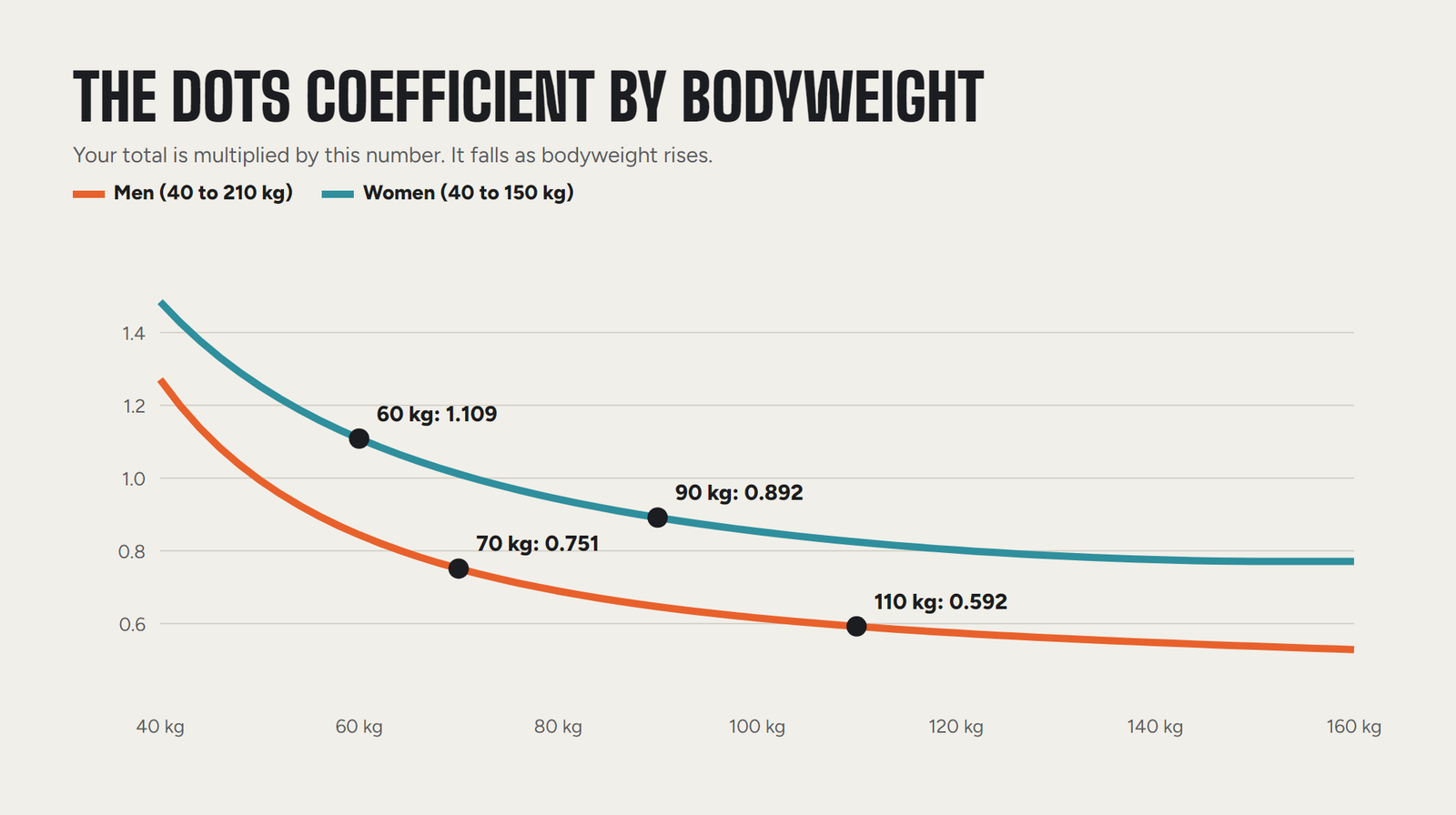
DOTS stands for Dynamic Objective Team Scoring. It's a formula that multiplies your powerlifting total by a coefficient based on your bodyweight and sex. Heavier lifters naturally lift more, so the coefficient gets smaller as bodyweight goes up. The result is a score that lets you compare lifters across weight classes, which is why meets use scores like this to pick a "best lifter" overall.
If you only know a training max, you can estimate your best lifts first with our one rep max calculator, then plug them in above.
The DOTS Formula
The formula is a fourth-degree polynomial of your bodyweight in kilograms:
DOTS = Total × 500 / (A×BW⁴ + B×BW³ + C×BW² + D×BW + E)
| Coefficient | Men | Women |
|---|---|---|
| A | -0.0000010930 | -0.0000010706 |
| B | 0.0007391293 | 0.0005158568 |
| C | -0.1918759221 | -0.1126655495 |
| D | 24.0900756 | 13.6175032 |
| E | -307.75076 | -57.96288 |
| Bodyweight range used | 40 to 210 kg | 40 to 150 kg |
These are the same values used in OpenPowerlifting's open-source code. Bodyweights outside the range are treated as the nearest limit. Everything is calculated in kilograms, so if you enter pounds, the calculator converts them first.
DOTS Score Examples
| Lifter | Bodyweight | Total | DOTS |
|---|---|---|---|
| Male | 75 kg | 500 kg | 358.7 |
| Male | 100 kg | 700 kg | 430.9 |
| Male | 120 kg | 750 kg | 430.7 |
| Female | 60 kg | 300 kg | 332.6 |
| Female | 75 kg | 400 kg | 389.6 |
Notice the 100 kg and 120 kg men end up level, at about 431 each. The heavier lifter totals 50 kg more, but DOTS says the two performances are about equally impressive for their size.
What Is a Good DOTS Score?
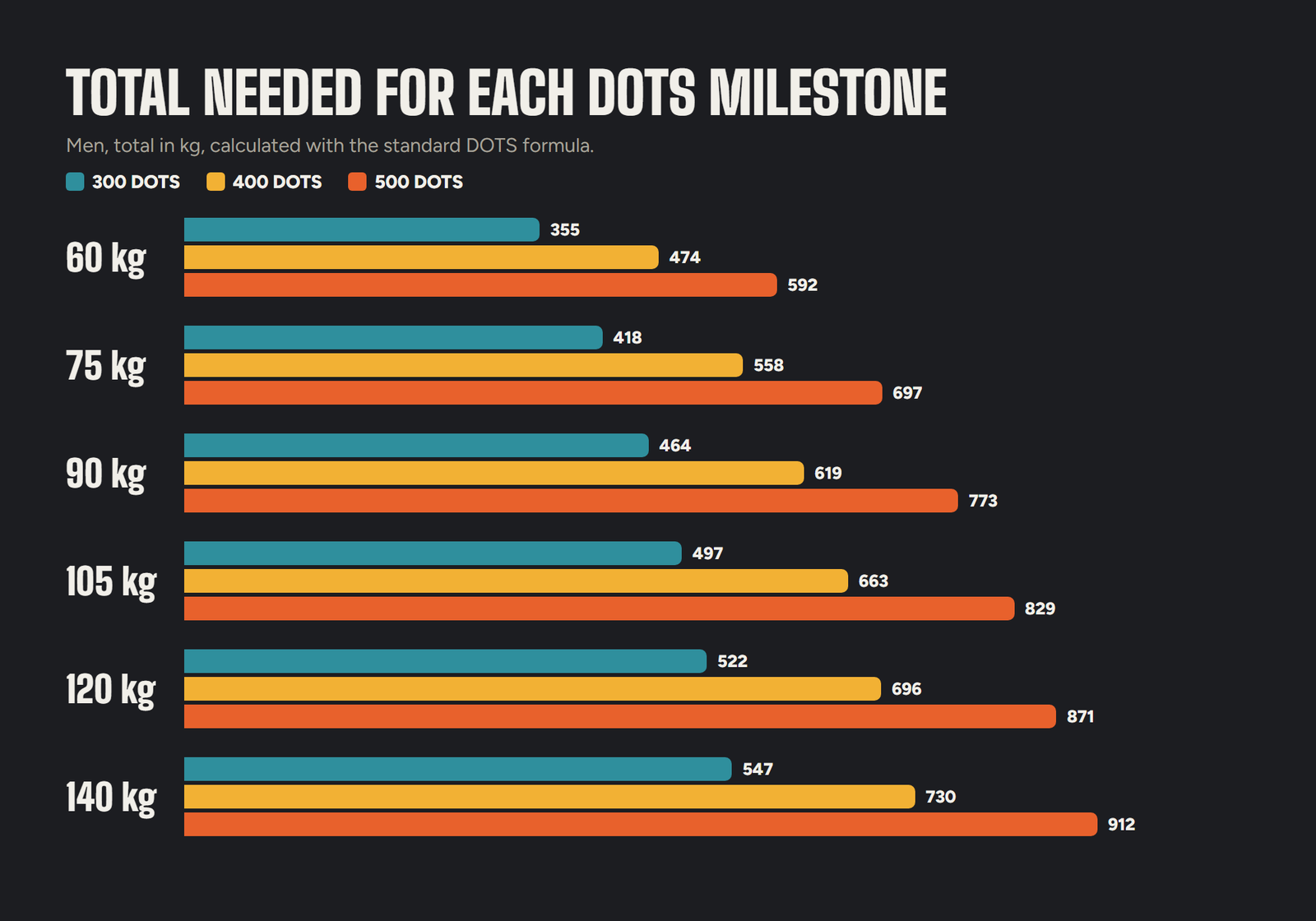
There's no official grading scale for DOTS. As a rough, unofficial guide, many lifters see scores around 300 as solid for someone with a year or two of training, 400 and up as a strong competitive lifter, and 500 and above as elite, national-level territory. Use the "total for 400 DOTS" and "total for 500 DOTS" boxes in the calculator to see exactly what those targets mean at your bodyweight.
Want another way to judge your lifts? Our guides to how strong you are compared to others and the strength level indicator break it down lift by lift.
DOTS vs Wilks vs IPF GL Points
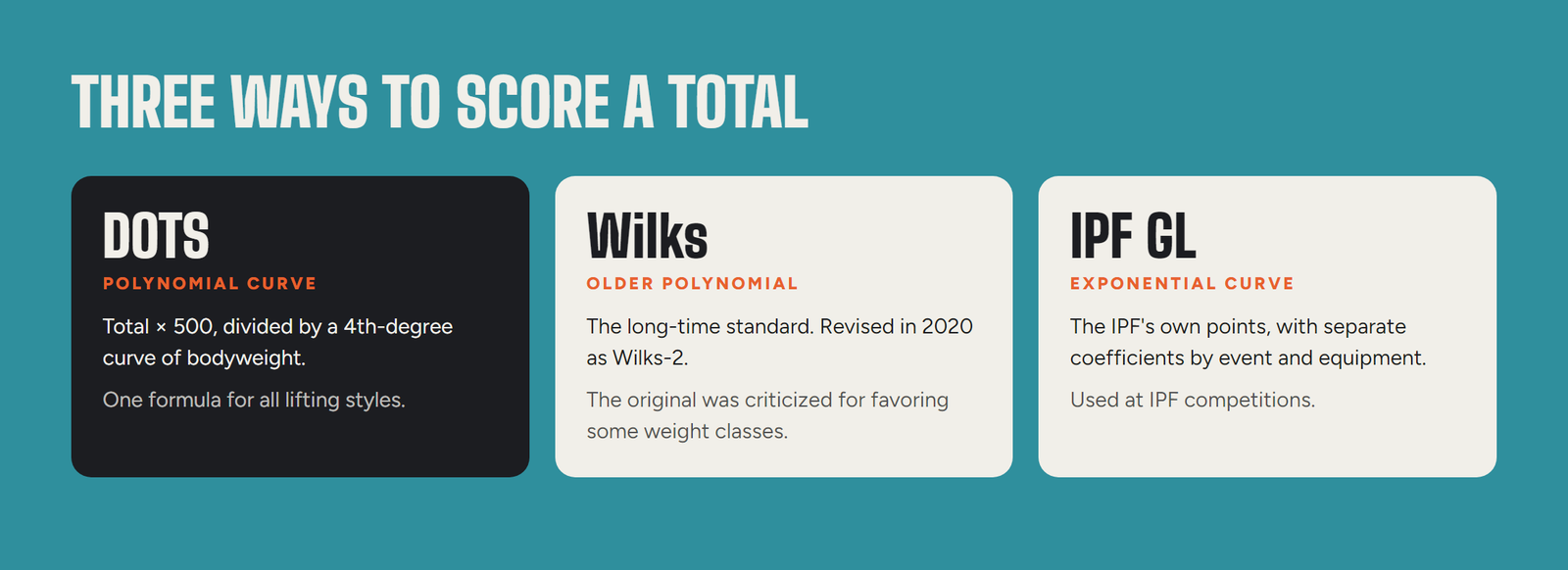
| Formula | How it works | Good to know |
|---|---|---|
| DOTS | Polynomial of bodyweight, total × 500 / curve | Simple, one formula for all lifting styles |
| Wilks | Older polynomial formula, revised in 2020 as Wilks-2 | The original was criticized for favoring some weight classes |
| IPF GL points | Exponential curve, separate coefficients by event and equipment | The IPF's own scoring system for its competitions |
Scores from different formulas aren't interchangeable. A 400 DOTS is not the same as 400 Wilks, so always compare like with like.
How to Raise Your DOTS Score
- Add to your total. Every extra kilo on any lift raises your score directly. Our rpe chart helps you train hard without burning out.
- Pick your weight class wisely. Losing fat while keeping your strength raises your coefficient, but cutting too hard usually costs more strength than it gains.
- Bring up your weakest lift. For most lifters, the lift furthest behind has the most room to grow.
Frequently Asked Questions
What does DOTS stand for in powerlifting?
DOTS stands for Dynamic Objective Team Scoring. It's a formula that adjusts a powerlifting total for bodyweight so lifters of different sizes can be compared.
How is a DOTS score calculated?
Your total in kilograms is multiplied by 500 and divided by a fourth-degree polynomial of your bodyweight, using separate coefficients for men and women.
What is a good DOTS score?
There's no official scale. As a rough guide, around 300 is solid for a newer lifter, 400 and up is strong and competitive, and 500 and above is elite.
Is DOTS better than Wilks?
DOTS was created as a modern alternative to the original Wilks formula, which was criticized for favoring some weight classes. Both aim to do the same job, but their scores aren't directly comparable.
Can I use pounds in the DOTS calculator?
Yes. Switch the units to lb and the calculator converts your bodyweight and lifts to kilograms before applying the formula.
Final Thoughts
Your DOTS score is the fairest quick way to see how your total measures up, whatever you weigh. Plug in your best squat, bench and deadlift above, check what total you'd need for the next milestone, and use that as your next training goal.